Submit my blog Hunting

Thursday, 15 September 2011

John Barleycorn is Unwell.....

For the second time in the past five years, the local pub has shut down. The curtains are closed, the car park is empty and cellar door is wide open. The landlord and landlady packed all their stuff into cardboard boxes and disappeared into the night; leaving a mess of debts, thirsty locals and a stripped out pub.

I guess we should be getting used to this by now. The previous incumbents did exactly the same. A moonlight flit and weeks of disruption to the local community ensued.

Rural pubs aren't what they used to be. They are less tied into the community than they ever have been. Take our local for instance; there used to be two pubs in the village, a rough and ready drinking pub and a smarter (but not much) eating pub. The drinking pub closed down more than fifteen years ago and has long been turned into executive housing. The local drinkers; the hunt, the rabbit men, the long dog men and all the other local nere-do-wells, moved to the posher pub, but it was an uneasy union. We wanted to sit in a pub where you could swear, drop your brace of pheasants and dogs in the snug, tell a filthy joke or two and not have to take your boots off or mind your language. The occupants of the executive housing wanted a gastro pub – coordinated paintwork (Farrow and Ball of course) minimalism, brushed chrome, and definitely no stinky beater's dog pissing up the curtains or in your Bolly! The occupants of the executive housing got their way, after all they have the money (don't they?) and they refurbished the pub from distressed functional charm to something that looks like the interior of George Michael's bathroom. But there was a problem; the occupants of the executive house were so worried about their mortgages and jobs that they forgot to come out and spend the credit card company's money. So the old boys were tolerated for their real cash, but they were told to clean up their act, leave their dogs and boots outside and definitely no dead things or guns on the premises. So eventually the old boys drifted away; some finding other more forgiving places to drink, some to the warmth of the allotment shed and a bottle....

In 2009, an independent study estimated that 52 pubs were closing each week – things have hardly have got any rosier since then. The increase in VAT to 20% and talk of a second wave of economic depression, all seems to have taken their toll on the viability of the rural pub. But it isn't just the economy that's sounding the death knell of the rural local; the real villains in this piece are the pub management companies who are playing fast and loose with an untenable business model and the morons who buy into their propaganda and think that running a pub is easy. Well, they have been on the pub management company course and have certificates to prove it.... what more could you need.

Pub groups such as Punch or Enterprise Inns care for only one thing; the bottom line. They care not a jot that the pub used to be the heart of the community, a meeting place, a focus, a lifeline. They only care for profit. If the current managers don't cut the mustard, there will be another idiot along in a minute wanting to spend his or her retirement fund to replace them; and generally there is!

And the moral of the story is "cater for your real market, not the one you would like to have!" If you want to run a restaurant, buy a restaurant. If you want to run a swanky designer bar, buy a bar in a city. If you are running a pub in the middle of the country the people who pay your wages don't wear designer suits and sip champagne, they wear green or tweed, probably smell a bit, drink pints, have lots of dogs and drive proper 4x4s, not Range Rovers. These are the only people who will be spending real money (the type that makes a noise and isn't plastic) in your pub in February, when it's snowing and the Audi TT won't make it off the block paving drive of your executive home. These people don't want designer cocktails and modern British food, they want it the way it used to be.

Warm, friendly and unrefurbished.

Thursday, 8 September 2011

‘Tis My Delight On A Moonlight Night.......


How things change. Gamekeepers have been having hard times over the last couple of years. Increased pressure to perform, increased pressure on shoot margins, inclement weather during rearing seasons and on top of that the profession is demonised in the media, attacked by the RSPB at every turn and had to suffer rouge individuals stupid enough to think that they can get away with poisoning raptors. It's enough to make you think about chucking it all in and becoming a poacher.

However, away from the propaganda of the RSPB, keepers are generally seen as key players in the stewardship of the countryside – a lynchpin in conservation and a deserving contributor to the success of the countryside. In reality, the lot of the gamekeeper is far better than it was a couple of hundred years ago.

If you want to know about the lot of the gamekeeper in the 1800s, you could do a lot worse than listen to some traditional folk music. There is a considerable body of English and Scottish folk music which focuses on the relationship between the gamekeeper and the poacher. Invariably the gamekeeper is portrayed in a bad light. A brutish thug, in thrall to the landed-gentry, whose sole purpose in life is to prevent the gallant poacher from earning a (dis)honest meal. Gamekeepers were often described as wandering in gangs, with cudgels and axes, to murder and brutalise at will, anyone who dared to trespass on their master's hallowed turf.

On the other hand, the poacher is rarely mentioned without being qualified as gallant, a likeable rouge, pushed into his exploits by the necessity of poverty and feudal penury. A dashing figure; the perfect foil to the dastardly keeper. Strong links are seen between the romanticism of the highwayman and the life of the poacher. 


The penalties for poaching were stiff to say the least. If the poacher was caught, if he survived the beating, he could look forward to deportation to the colonies aboard a hell-ship. Poaching songs are usually adventure songs, about the thrill of the moonlit night, and the eternal contest with the gamekeeper. The better ones also comment on the iniquity of the squire owning so much when poor folk are starving, and are often linked to the barbarity of the legal system of the late 18th and early 19th centuries.

In the traditional Yorkshire song "Rufforth Park Poachers" a band of 40 poachers take on the Rufforth Park keepers leading to the death of Roberts the Head Keeper. Only four of the gang were caught, tried and deported for the murder.

A buck or doe, believe it so, a pheasant or a hare
Was set on earth for everyone quite equally to share
So poachers bold, as I unfold, keep up your gallant hearts
And think about those poachers bold, that night in Rufford Park
In the Death Of Poor Bill Brown, the rather inept poacher Bill is killed by the gamekeeper as he attempts to take a deer, but his death is avenged in gory detail as his companion shoots the keeper in the back.

One starry night as you shall 'ear,
All in the season of the year,
We went to the woods to get a fat buck,
But ee that night we 'ad bad luck,
For Bill Brown got shot and 'is dog got stuck.
In all my time that I have loved English folk music I have never come across a song that glorifies the keeper or even represents him fairly. Even in relatively modern protest songs such as Manchester Rambler, written by Ewan McColl, concerning the mass trespass on Kinder Scout, keepers come out with a bad press.

The day was just ending and I was descending
Through Grindsbrook just by Upper-Tor,
When a voice cried, "Hey, you!", in the way keepers do,
(He'd the worst face that ever I saw).
The things that he said were unpleasant;
In the teeth of his fury I said
"Sooner than part from the mountains,
I think I would rather be dead"

He called me a louse and said "Think of the grouse".
Well I thought, but I still couldn't see
Why old Kinder Scout and the moors round about
Couldn't take both the poor grouse and me.
He said "All this land is my master's".
At that I stood shaking my head,
No man has the right to own mountains
Any more than the deep ocean bed
Why is it that in the canon of English and Scottish traditional music, the gamekeeper's image is that of dullard and thug, whilst his opponent the poacher is a gallant romantic figure, hard done by, by both the state and gentry? Well perhaps the old keepers were thugs and perhaps intolerable social injustices drove normally honest men to commit the "crime" of poaching in order to feed their families rather than see them starve. All that daresay had a part to play.

Perhaps however, poachers had more time to write songs than keepers; more time to weave an unreality of spin and PR. Certainly McColl was a socialist (to say the least) who disapproved of the idea of land ownership, and liked nothing better than to tilt at the English Class system and those who he perceived perpetuated it.

This vision of the roles of the gamekeeper and poacher is pretty different from modern day perceptions (or is it?)

Why does the devil have all the best tunes? Because he writes his own press release! That's why.

We would do well in current times to remember that in the future we may be judged not by our deeds, but by what is written about them. We should choose those who elect to speak on our behalf with the utmost care lest our best intentions be misrepresented.


Sunday, 14 August 2011

Feet on the Ground, Head in the Clouds


As my wife tells me, I am a grumpy old man, not fit for polite company. Good, because I don't much care for company.

I adore hill walking, particularly in very high places with very few other people. I love the solitude and the contemplative nature of walking in wilderness. Yet it is truly hard to find real solitude, no matter how high you go, how much it hurts to get up there or how early you get up on a morning. There is generally some other hardy soul up there, trying just as hard to get away from you as you are from them.

I'm not totally inured to the pleasure of walking in company – it's great to be able to turn to someone and share the delight in a breathtaking view or a joke to lighten a painful ascent. But for the most part I'm very choosy who I walk with. I love walking with my son Connor – he brings a different dimension to my walking. For him it's all about harder, faster, better – he likes to know how fast he's walking, how many miles we've covered and how much faster we did it compared to last time. He's a good foil to me; I like to walk at a pretty quick pace, but it's not all about speed; much more it's about taking in the beauty of our world and finding space to hear your inner voice. I hope that I slow Connor down just long enough for him to see the splendour of the landscape and I hope he goads me into pushing myself harder than I would naturally. A good compromise on both sides. I hope he'll continue to walk with me for a long time.

It's hard to find a walking partner. Silence is just as important as conversation......

All of which means I don't go on many family walks. Until recently the kids were too young to take up really high and Anita doesn't see the attraction. All the more surprising then, when she suggested a "proper" family walk this weekend. Family walking for us normally consists of somewhere flat, usually near a river, with frequent stops for food. All of which is very nice, but it's not walking – it's a picnic. I normally get grumpy because I've been promised walking and have to settle for a stroll in the valley, next to a river I can't afford to fish, when all I really want to do is get up high.

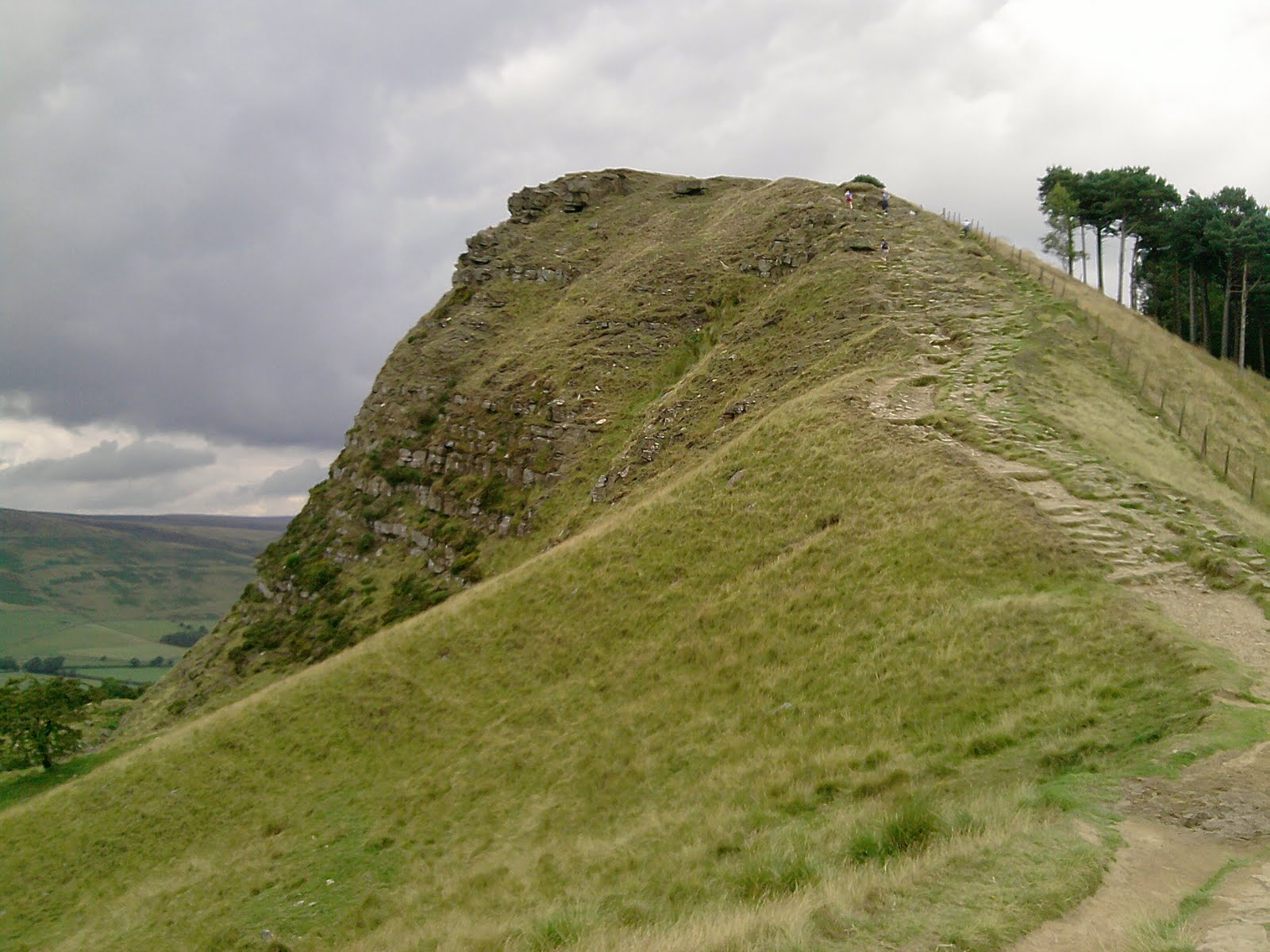
Today however was different; proper walking was on the cards. And indeed it was; whilst it wasn't the highest or hardest walk in the world, it was a proper family walk on Mam Tor in Derbyshire. Good start, let's have some more!

I may even learn how to behave in polite company if this carries on!


Thursday, 4 August 2011

Orchards’ End


The old apple tree in the back garden finally succumbed to the ravages of time whilst I was away in Scotland. I came back to find it had demolished the roses, but missed the greenhouse.

Sad to think that it had stood there for nigh on 150 years.

It was planted by my great grandfather as part of a substantial orchard at the back of the farmhouse. This tree was the last of that orchard. The poor old thing had seen off two World Wars, as well as the selling off of the farm. Unfortunately it couldn't see off the rot that set in its' heartwood. I feel sad that such a majestic old tree has gone. I am going to plant another tomorrow – it seems only right.

The wood is far too precious to burn for heat, although having said that apple wood makes a pretty good fire – marvellous smoke. And there is the key; lots of the wood will be used for hot and cold smoking. Some will go up to my friend Andy Richardson in Fife, where I hope it will see some salmon or maybe a sea trout. Some of the bigger bits I hope to get turned into bowls. Something to remind us of the end of a legacy.

Then there are the apples – not fully ripe unfortunately, but ripe enough to make chutney and ideal for cider. Maybe we can drink it from the wooden bowls?


The Shoot Benchmarking Report


A pdf of this can also be found here

Shoot Benchmarking

I've just received a copy of the Shoot Benchmarking report 2011. This is a joint venture between Guns on Pegs and the sporting agents, Smiths Gore, to survey the shooting market to assess a number of key parameters that can be tracked across time.

It makes for interesting reading....

The first thing to say is that this is laudable effort from the two companies and as a piece of research is a pretty good tool. This is only the second year that this survey has been undertaken, and I for one look forward to the time when the survey becomes a bit more established and some real trend data can be properly assessed.

I'll append the full report for anyone who wants to go through the detail, but it is also available here here .

I spent a good deal of the 20 years that I worked commissioning and looking at market research, so I hope that I can view this from a professional perspective.

Firstly, there are a number of weaknesses of the study; the sample base is only 110 shoots – a very low number when you consider how many shoots are running at either a DIY or commercial level in the UK at the moment. This is in no way a statistically representative quantitative sample – it is however a pretty robust qualitative sample with lots of numbers. This is important because in effect it means that findings from this report cannot be interpolated for the whole population of UK shoots. A shame...let's hope they get much more participation next year.

Secondly, data is not split between England, Scotland, Wales and N. Ireland, which I think is a mistake. Obviously data has been aggregated as I would surmise that there are insufficient data in each cohort for a statistically significant result. This is a shame as highlighting inter-regional differences is not only interesting, but also important.

Thirdly, they have opted to split the data by Commercial vs. Non-commercial shoots. Shoots were able to decide for themselves if they were commercial or non-commercial. This can lead to significant errors in the data; shoots were advised that this decision should be based on if the shoot had any "let" days or not. However, you can envisage a small shoot that maybe has one or two lets days considering itself a commercial shoot and a shoot that has ten let days, not considering that this is sufficient to be considered commercial. This distinction needs to be tightened up, perhaps based upon a combination of the number of let days sold and number of birds put down?

Finally, they don't actually say who they have spoken to.....is it solely gamekeepers, as in the recent NGO survey, or it is a combination of gamekeeper, factor and the Shoot captain.....For it is my experience that the wide variety of data reported here is rarely held in a single pair of hands in a shoot. Rather the gamekeeper will be expert in the bird numbers and returns, whilst others will be in a better position to talk about profitability.

However, enough griping, this is an interesting report and as such should be applauded.

110 shoots were surveyed, accounting for 2,400 day hooting between them, over 350,000 acres of land, with a total of 1.1 million birds released.

Let's have a look at some of the really interesting findings...

Firstly, bag sizes on commercial shoots were not massively bigger than on their non-commercial counterparts; the average bag size for a commercial shoot in this survey was 200, in comparison to 110 for non-commercial shoots. This is an encouraging finding, as tales of very large bags abound. However, it should be remembered that market research is a pretty poor tool at getting to the real truth rather than the perceived truth. Bag sizes showed little variation between let days and private days, irrespective of commercial or non-commercial shoot.

Secondly, the internet is playing an increasingly important role in finding shooting. Whilst word of mouth recommendation and repeat business were the two key methods of finding shooting, the role of the sporting agent suffered at the hand of internet sites such as guns on pegs.

Guns paid an average of £30 + VAT for pheasants and partridge (range £26 to £32)

Increases in corn and fuel prices drove up the fixed costs running a shoot however commercial shoots were adept at controlling variable costs to contain the overall cost of shooting. Non –commercial shoots were less willing or able to control variable costs.

Consequently Keepers salaries remained the same as seen the previous year (£20K for head keeper, £16K for gamekeeper), however benefits in kind such as housing, utility bills, clothing... were reduced to control costs.

Profitability seems to be a function of the ability to control fixed costs and having greater numbers of let days. The most profitable shoots had the highest number of released birds and the highest number of let days.

Fascinating stuff. Let's hope some of the wrinkles get ironed out next time they do it.

How

Sunday, 31 July 2011

Why is the Shooting Media so obsessed with the Top End?


I've just got around to reading the August edition of The Field. Any shooting publication that isn't being deliberately obscurest is likely to feature grouse rather prominently at this time of the year. I don't have a problem with that. I love eating grouse and I'm normally lucky enough to get a few during the season. I'd dearly love to shoot grouse, but I've resigned myself to the fact I'm too poor and poorly connected to ever get the chance.

Grouse shooting is rather "Top End" The elite face of shooting; difficult, cripplingly expensive and dare I say it, rather cliquey. Rather more Top End than most driven pheasant and definitely more Top End than Wildfowling or pigeon shooting. Krug as opposed to Cava.

But it isn't the obvious emphasis on the upcoming 12th that caused me to stop reading the current edition of The Field; it was the sheer lack of balance.

Shooting is a broad church but it seems that our shooting magazines are rather obsessed with the elite aspects of our sport. You only have to cast your eye over the contents to realise that ferrets aren't going to feature in any great prominence. Buffalo shooting in Africa, Which is the best Yacht, Shooting patridge on the Duke of Norfolk's Estate. Hang on what's this, an article on vermin control..... oh no it's luxury ratting with champagne.


I am trying to imagine what impression an outsider to shooting would get if they picked up a copy of the current issue of The Field – probably an unhealthy reinforcement of every stereotype associated with field sports. Braying hoorays, toffs, elitist snobs and segregated luxury. But I have to say what really did it for me is the piece on Tarquin Millington-Drake (no I am not making this up!) a self confessed salmon fishing addict, shown in all his glory across a page and half spread with a rather magnificent 39lb salmon. I'm sure Mr Millington-Drake is a delightful man, kind to his mother and generous to a fault; but please...........Tarquin??? Don't we have anyone out there called David who is addicted to salmon fishing?

Is there any point in publishing a list of the top 100 shots in the UK? Who the hell decides who goes on the list? Obviously if you are George Digweed your provenance is beyond doubt. But what about the rest? How do you quantitatively decide who is a better driven shot between Mike Yardley and James Percy? And more to the point, what bloody purpose is served by publishing a list, apart from massaging the already inflated egos of the Top End.

As we are constantly reminded, shooting is under siege from those who'd rather we didn't do it. Reinforcing widely held stereotypes, be they right or wrong, cannot be doing us any favours.

I for one will be holding off buying The Field and Shooting Gazette for a while, in favour of a rather good monthly publication; Modern Gamekeeping. This is a down to earth, warts and all, magazine targeted at those involved in the shooting industry. Sense and practicality and not at all Top End.